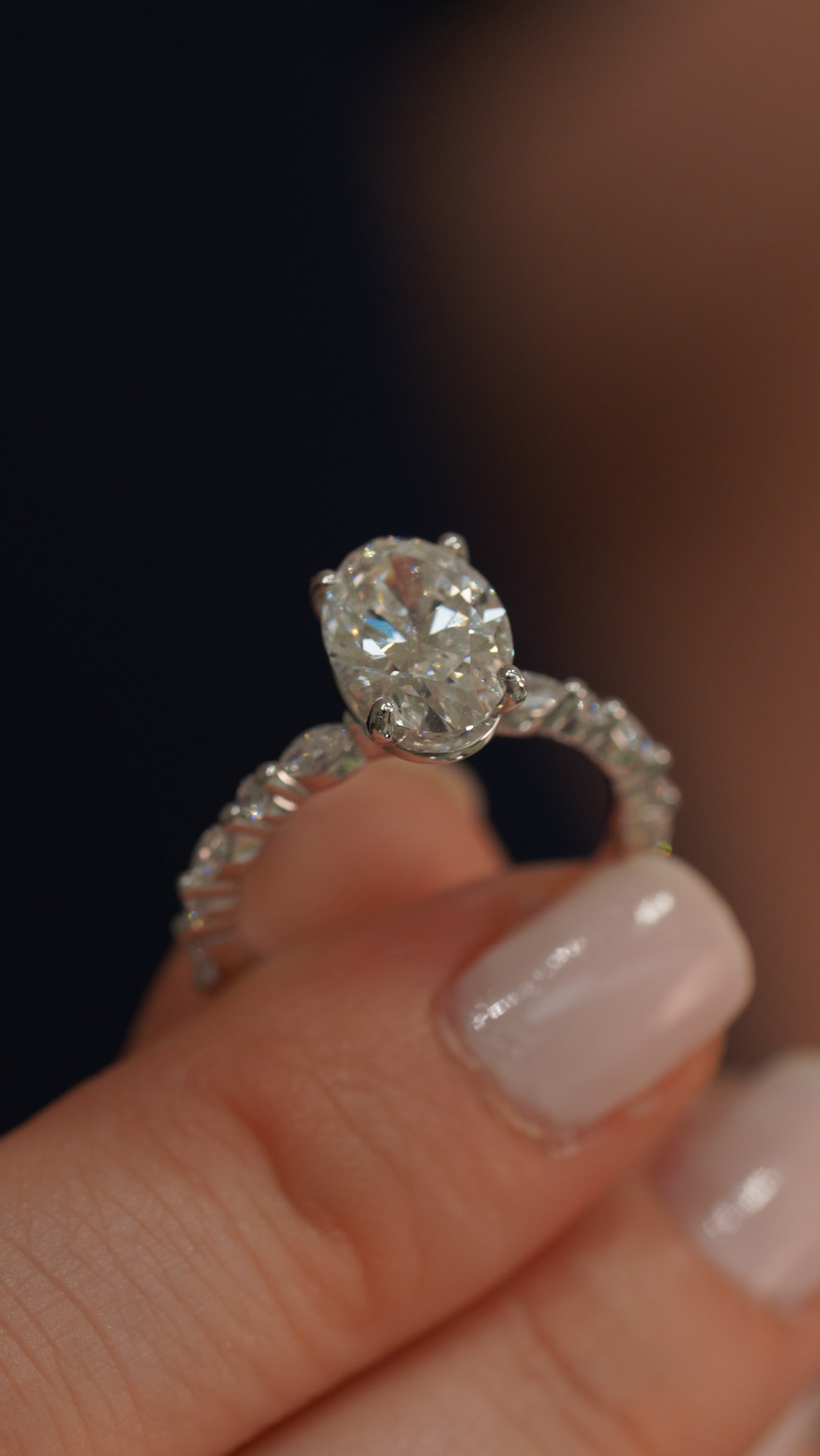
Most people start with carat, because it is the only measure anyone talks about. Yet it is the cut that decides how a stone looks on the hand. Below we take the four measures in turn, and where you can give ground without anyone seeing the difference.
Four measures: carat, cut, colour, clarity
Diamonds are graded internationally on four points, all beginning with C, hence "the 4Cs".
- Carat: the stone's weight, not its size.
- Cut: its proportions and workmanship, which decide how light is returned.
- Colour: a scale from D (colourless) to Z (yellowish).
- Clarity: how many natural inclusions the stone contains.
Cut: the one that creates the sparkle
A diamond looks alive because of its cut. A stone with correct proportions sends incoming light back up through the top. Cut too deep or too shallow and the light escapes out of the side, leaving the stone flat no matter how large the carat weight.
If your budget is fixed, do not compromise on cut. A well-cut 0.90 carat stone will almost always outshine a poorly cut 1.10 carat one.
Colour: where it makes sense to stop
The scale starts at D (entirely colourless) and runs to Z. D, E and F count as colourless; G through J are "near colourless" and, once set, are very hard to tell apart with the naked eye.
One practical point: set the stone in yellow gold and that warm colour reflects into it anyway. A stone around G or H then looks near-identical on the hand to a D, at a noticeably friendlier price.
Clarity: "eye-clean" is the real test
Almost every natural diamond contains inclusions formed over millions of years. Clarity measures how noticeable they are. FL and IF count as flawless; in the VVS, VS and SI grades inclusions become visible under a loupe.
What usually matters is whether a stone is "eye-clean": no inclusions visible to the naked eye at normal viewing distance. Plenty of SI stones qualify, at a considerable saving over VVS. What settles it is not the letter on the certificate but what you see when you look at the stone.
Certification: who issued it?
A certificate shows that an independent laboratory measured the stone. Who issued it matters as much as having one, because laboratories do not grade equally strictly.
The internationally recognised names are GIA, IGI and, widely used across the Benelux, Antwerp-based HRD. Ask to see the certificate for your stone and check that its number matches the stone itself.
Lab-grown diamonds
Lab-grown diamonds have become common in recent years. Chemically and physically they are identical to natural diamond; only their origin differs. They are not imitations, and they cost markedly less.
Against that, their resale value behaves differently from natural stones. If you want a larger stone for the same budget, they are a sensible choice; if long-term value comes first, natural stays the route. Whichever you buy should be stated explicitly on the certificate.
Before you buy the ring
A few practical points make the decision easier:
- View the stone under different lighting. Display lighting flatters every stone; daylight is honest.
- The setting changes the look. An open setting admits more light; a closed one protects the stone better.
- Have the ring size measured in the middle of the day; fingers measure differently morning and evening.
- If it will be worn daily, try it on together with the wedding band at the same time.
Take your time
A diamond is bought with the stone in your hand. Two stones with identical certificate grades can look different because of how they were cut.
At our shop on Javastraat you can compare stones side by side without rushing, and we will talk through where giving ground would show least in your case.